


Understanding Your Current Writing Situation
You are an (English language learner) writer and you receive feedback from your instructor that you need to increase your originality score (based on a report from originality.ai) and/or your instructor has said, “Your text does not sound like you.”
Assume the following:
An originality score of 100% indicates the likelihood that text was derived from a human. Ideally, one’s originality score should be between 85%-100%.
Using translation software (e.g., Google Translate, etc.), grammar editors (e.g., Microsoft Editor, Grammarly, etc.), and any LLMs (e.g., ChatGPT, CoPilot, Gemini, etc.) that generate text are likely to negatively effect one’s originality score. It’s best to develop a first draft without using any type of technology and then go from there(e.g., writing out text in a notebook, etc.).
As one learning English as an additional language, moments of awkwardness and some degree of non-standard English is to be expected and encouraged. It’s your original voice, it’s how you sound, it’s your interlanguage, which is to be embraced!
If you read this text and feel compelled to argue against the validity of Originality.ai or AI detectors in general, don’t. I’m familiar with the argument.
Using an AI detector is meant as a form of dynamic assessment in that it is both summative and formative (with an emphasis in the latter).
An originality score is one of many indicators that point to areas where revision is needed: writing unity, coherence, and cohesion.
Using a dictionary and thesaurus is encouraged if used only to find individual words and not phrases or chunks of language.
The process of writing is more important than the final draft.
Evidence of understanding through the process of writing is multimodal; multiple means of expression and communication as part of a universal design supports a thinking-to-writing and writing-to-thinking iterative and reciprocal process.
Your instructor is in your corner, so any clarification, motivation, and revision needed requires transparent and close communication.
Creating Clear, Cohesive, and Authentic Writing
Review the M.E.A.L. Plan as needed to review how individual sentences within a body paragraph function when developing one main idea: topic sentences that present the main idea of a body paragraph; evidence sentences as specific facts, details, examples, and/or statistics that support a topic sentence; analysis sentences that connect the evidence to the topic sentence; and a linking or summarizing sentence.

Another factor to consider when revising your text is the type of paragraph you are writing. Modifications to topic, evidence, analysis, and linking sentences depend on whether you are writing an expository, narrative, argumentative, comparative, etc. paragraph. Perhaps you are writing a cause-and-effect or process paragraph. Finally, are you writing an introduction, body, or conclusion paragraph? It matters.
Unity
Take the following example (generated by AI but representative of what I often see in the classroom) where citations were deliberately omitted for the sake of this discussion. Text highlighted in red, orange, and yellow indicate where AI was detected, from a greater to lessor degree.
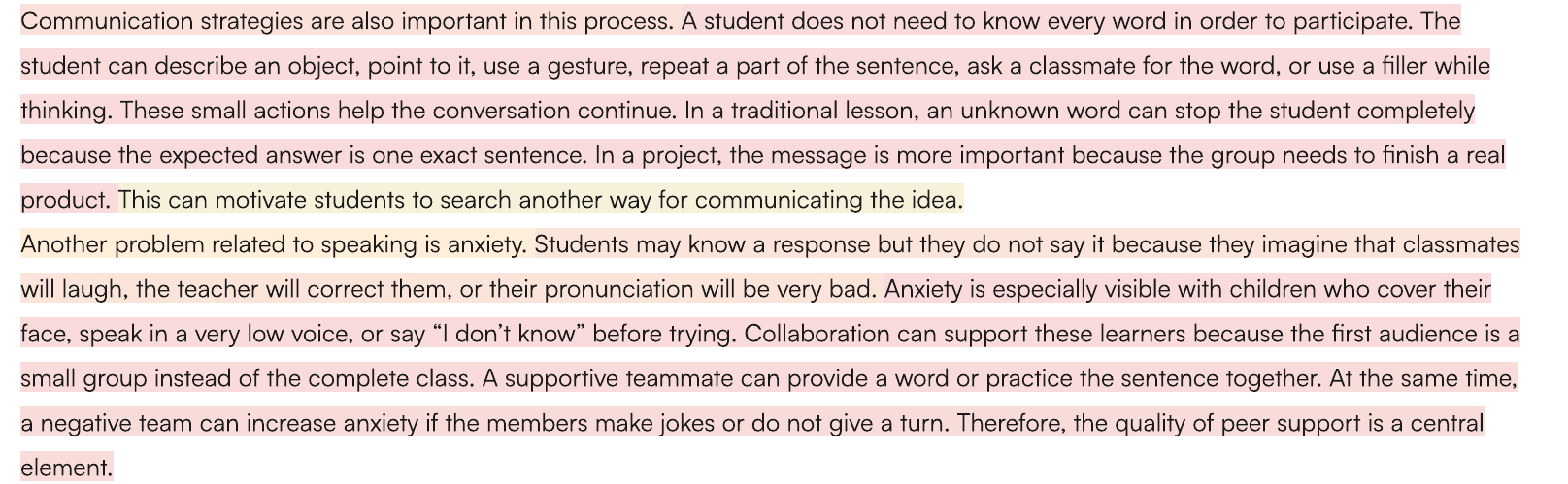
Approach revisions for each sentence depending on the type of sentence it is.
Communication strategies are also important in this process (topic sentence): General suggestions like avoiding linking verbs in the main clause of the topic sentence; avoiding subjective words like, “important”; and overusing demonstratives (i.e., this, that, these, and those) can go a long way in writing a more descriptive and specific idea. Compare the example sentence above with the following: “Proficient language learners maintain an ongoing conversation through implementing linguistic and non-linguistic strategies.”
Evidence sentences: The second and third sentence of the first paragraph could include specific facts, details, examples, and/or statistics that relate, compare and contrast, etc. linguistic and non-linguistic communicative strategies speakers use to keep the conversation going.
Analysis sentences: Starting with “These small actions…” begins the analysis which will depend a lot on changes made to the topic sentence and evidence sentence. Notice how “small actions”, “traditional lesson”, and “in a project” leads to ambiguity and possible getting off topic. For example, if the intention is to compare a “traditional lesson” to one that is more communicative, then this should be the focus throughout the paragraph.
The linking sentence: If the intention is to segue from communicative strategies to motivation, replacing the demonstrative, “This…” with some transitional phrase or clause that paraphrases a point made earlier in the paragraph would again be a way to write more descriptively.
Although all of these sentences in the first paragraph above need revisions, sometimes revisions will require changes to any sentence depending on how it fits with sentences are were marked as being detected by AI.
Coherence
Mix sentence types.
Maintain a good balance between hedging and boosting.
Absolutes: always, never, everyone, etc.
Clearly, obviously, etc.
Boosting within reason with modals: “must”, “have/has to”, etc.
Hedging within reason: avoid overusing the same modals, especially, “can”: “may”, “might”, etc.
Watch for listing items of three or more.
Nominalizations.
Here are three examples of sentences (provided by ChatGPT 5.6) with excessive nominalizations (where verbs have been unnecessarily turned into nouns, making the writing more abstract and difficult to read).
Excessive nominalizations:
The implementation of the evaluation of student participation resulted in the identification of areas requiring improvement.
Improved version:
Evaluating student participation helped identify areas that needed improvement.
Excessive nominalizations:
The completion of the analysis of the interview data facilitated the development of recommendations for curriculum improvement.
Improved version:
Analyzing the interview data helped us develop recommendations for improving the curriculum.
Excessive nominalizations:
The provision of feedback contributed to the enhancement of students’ understanding and the improvement of their writing performance.
Improved version:
Giving feedback helped students understand the material better and improve their writing.
Does your text sound like you, but not how you speak.
Cohesion
Are you overusing sentence connectors?
Use linking sentences to maintain flow from one body paragraph to the next.